


Research shows it only takes 56 seconds to make a human connection. That may not sound like a lot of time, but for providers and nurses at The University of New Mexico Hospital, 56 seconds has gone a long way in making meaningful connections with the thousands of patients that come in for care.
It’s all part of the Commit to Sit initiative, a nationally recognized evidence-based practice recently implemented in clinical spaces at UNM Hospital.
When you’re in a hospital bed trying to get treatment, it can feel intimidating having an endless parade of health care workers coming in and out of your room, said Justin Miller, MD, vice-section chief for Hospital Medicine at UNM Hospital. That’s why those first few seconds of interaction are crucial.
Miller said the Commit to Sit program ensures providers and nurses are taking just a few minutes with patients to sit and make a heart-to-heart connection, which not only puts patients at ease but also humanizes providers.

These little moments where you're able to reach out and connect with a patient, you get to see them as a person and not just a patient, but they also get a chance to see us as people and not just physicians.”
- Justin Miller, MD, UNM Hospital vice-section chief for Hospital Medicine
The practice also creates a less rushed environment to talk about patient care, Miller said.
So far, he’s seen better treatment outcomes because of the safe space created by sitting, even just for a minute.
“There are a lot of things that come up that would not have necessarily come up otherwise, that greatly impact patient care,” Miller said. “Whether it's having some problems at home or troubles affording medication, or even just transportation to and from appointments, and those are things we can help with.”
It may not seem impactful to spend such a short amount of time with patients, but Miller said the difference is palpable.
“These little moments where you're able to reach out and connect with a patient, you get to see them as a person and not just a patient, but they also get a chance to see us as people and not just physicians,” he said.
Sitting in the Data
UNM Hospital has been tracking data collected to analyze improvement in patient outcomes and experience since starting the program in 2023.
Patients may receive a survey from the Hospital Consumer Assessment of Healthcare Providers and System (HCAHPS) when they’re discharged. A portion of the questions ask about patient experience and nurse/doctor communication. Miller said these questions are considered key drivers in improving patient experience and clinical outcomes.
UNM Hospital saw survey results improve over time overall for units participating in Commit to Sit.
In 2022, before Commit to Sit was implemented, nurse communication was scored at 72.6%, according to Jennifer Rice, UNM Hospital patient experience manager. Doctor communication scores was scored at 69%.
After implementing Commit to Sit, those scores have increased each year. Currently, nurse communication is scoring at 78%, and doctor communication is scoring at 81%.
Rice said her department started asking patients if any providers took time to sit with them during their hospital stays in September of 2024.
This data pictured below shows how quickly providers and care staff incorporated Commit to Sit into their daily routines, with 83% of patients reporting someone asked to sit with them.

Rice said the pilot program started in parts of the Progressive Care Units in the hospital. Once it proved successful, it was expanded throughout the inpatient floors of the hospital, the Adult Urgent Care, Pediatric Urgent Care and the Pediatric Emergency Department. There are plans to continue the program into the new Critical Care Tower as well.
Since starting the program, Rice said there has been an increase in positive patient comments that list nurses or providers by name.
Dr. Paterson is the absolute best in health care and surgery. He sits down and LISTENS to my questions and concerns and helps ME develop a plan.
- Patient comment from survey
The Patient Relations Department posts QR codes within the hospital where staff can self-report how often they’re able to sit with patients and report any barriers they’re facing.
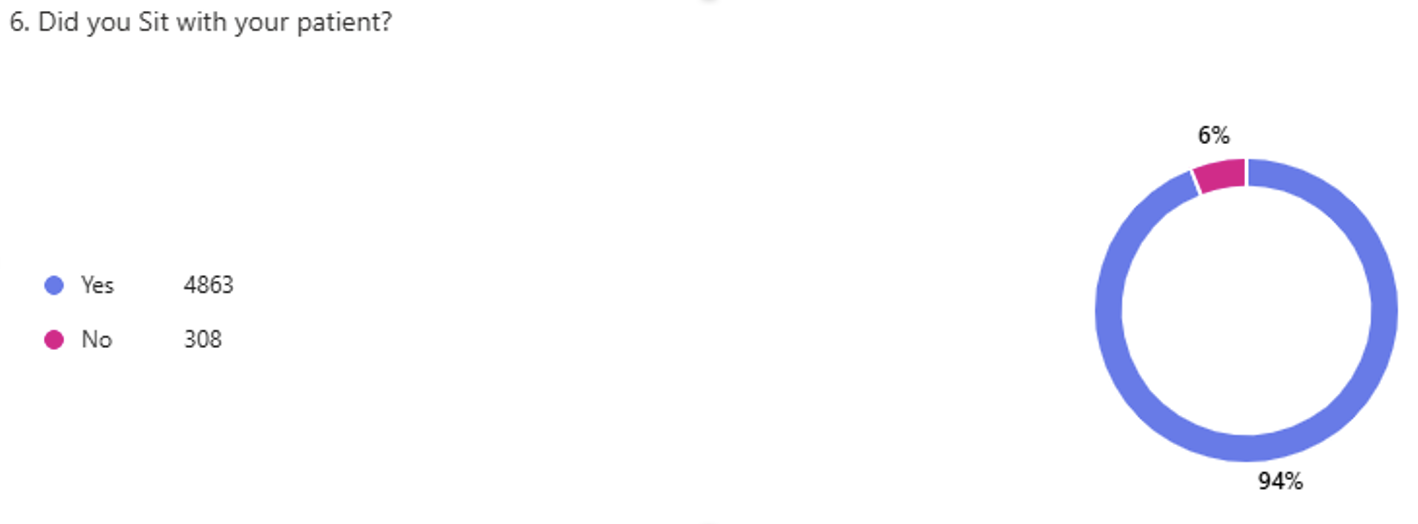
The hospital began tracking this data to get feedback from providers and nurses as well. It’s a voluntary survey, and so far, those who have scanned the QR code reported that 94% of the time they have sat with their patients. This shows the individual commitment by hospital staff to actively practice committing to sit with patients, Rice said.
Committing To a New Normal
The 2020 COVID pandemic brought about countless challenges for millions of people all over the world. In the health care sphere, there were very specific challenges, like how to make meaningful connections with patients behind a wall of personal protective equipment (PPE).
Brianna McCann, RN, BSN, RTSCBC, who is an RN unit based educator, said making patients feel heard is one of the most important parts of care. She has noticed how big a difference that makes when making her rounds.
“For some patients, that's all they really need,” McCann said. “They're alone for X-number of hours, sometimes all day and sometimes they don't even have family.”
McCann has been a practicing nurse for more than six years. A lot of that time was spent behind PPE that created physical boundaries between her and her patients.
“My normal practice was to ask to sit and chat, and then COVID happened, and we became very distant, staying back, not taking that time with patients,” she said.
Miller said he also experienced the distance during the pandemic, recounting how his students had to learn to care for patients from afar when sitting next to them wasn’t an option.
“During COVID, we were working in an environment where a lot of our trainees and young professionals were not in an environment where something like sitting with our patients was how things used to be,” Miller said. “You go through medical school and do training on how to appropriately treat patients, and you lose some humanism along the way.”
After the hospital implemented Commit to Sit, Miller said he gets a daily dose of connecting with patients and offering the best care possible.
“That’s the original reason why you go into medicine in the first place,” he said.
You can read more about Commit to Sit at UNM Hospital here.


