UNM Cancer Center
Media Contacts
Call or text:
505-548-0927
Email Jeff Tucker
Email Michele Sequeira
For nearly all her life, Rita Logan has been battling the sun.
That battle would eventually bring her to the University of New Mexico Comprehensive Cancer Center, not for treatment of cancer, but for a rare, genetic blood disorder.
“We were a very outdoorsy family,” Logan said. “We never went anywhere but fishing and I was always miserable. There are home movies of me sitting in the little bit of shade I could find. I could just see the expression on my face.”
Logan said her sensitivity to the sun was more than just an easy sunburn.
When she was 12 years old, she was with her mother's family on a picnic in the Manzano Mountains, playing baseball with her cousins and having a great day. But when she woke up the next morning, she felt like her body was swollen and painful.
“There were no blisters. Just swelling and I felt the pain. And then, all of a sudden, I just said, ‘It’s the sun.’”
For the next few decades, Logan would have to live with knowing what the cause of her pain was, along with the mystery of why it was so.
Solutions also were rudimentary.
Sunscreens at the time were a thick and greasy mess. So often, Logan would cover her skin as much as possible or just avoid the summer sun altogether. It wasn’t that she lived as a shut-in, but finding shade was always a priority and hats and long-sleeved shirts were essential, regardless of the temperature.
“All through elementary school it started right away in March,” she said. “I never wanted to go outside. It would last all through the fall. I was instinctively, I think, avoiding the sun.”
Logan would spend her childhood this way, even until she was married at 20 and living with her husband on a military base in Germany. Her best friend there enjoyed sunbathing, and Logan said she was still at a loss for how to deal with her allergy.
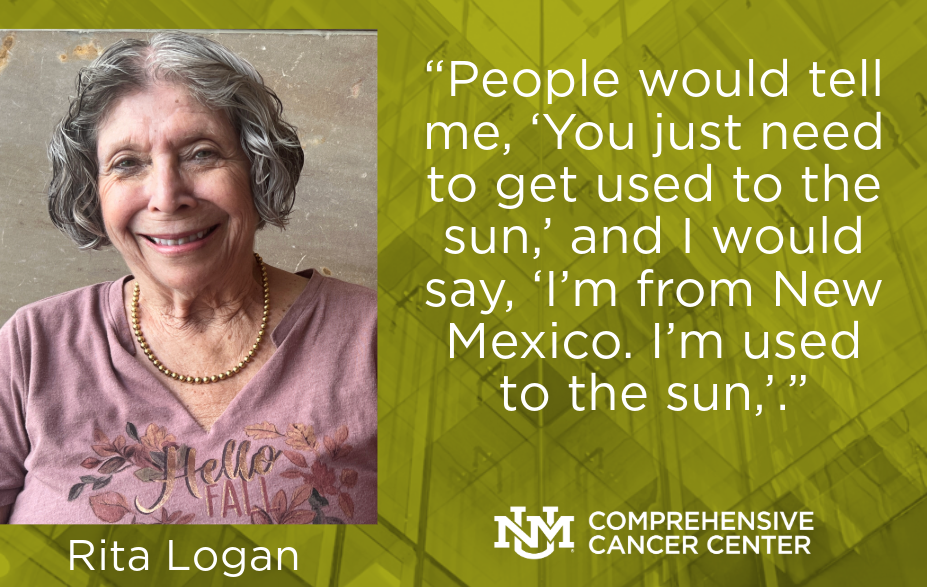
“People would tell me, ‘You just need to get used to the sun,’ and I would say, ‘I’m from New Mexico. I’m used to the sun,’” she said. Nevertheless, Logan said she would try to get acclimated to the sun and once woke up with burst capillaries in her legs.
When she returned to the U.S. and enrolled at UNM, doctors at the student health center finally diagnosed her symptoms: Erythropoietic protoporphyria, or EPP.
EPP is a genetic condition that causes a large accumulation of protoporphyrins in red blood cells, causing acute and painful photosensitivity.
While she had a diagnosis, it would take a few more decades of bundling up during summer before she could find a reliable treatment at the UNM Cancer Center and its Classical Hematology Clinic.
“Hematology, in general, is a field of medicine that studies blood disorders,” said Ala Ebaid, MD, an assistant professor of Hematology/Oncology and director of the Classical Hematology Program at the UNM Cancer Center.
Under the general practice, hematology breaks down to three subspecialities:
- Malignant Hematology, which treats cancer and blood disorders such as lymphoma, leukemia and myeloma.
- Cell Therapy, which focuses on stem cell transplant and chimeric antigen receptor T-cell (CAR-T) therapy, which utilizes white blood cells to fight cancer.
- Classical Hematology, which treats a broad range of noncancerous blood disorders and chronic blood cancers that don’t necessarily fall into the “malignant” category.
Positioning a classical hematology clinic within the UNM Cancer Center is ideal, Ebaid said, because the center has experts in all three fields and the team approach is essential in giving patients the best care.
Logan’s condition is rare and genetic, but the classical hematology clinic also treats more common maladies.
“In general, we treat noncancerous blood disorders, blood clots, bleeding disorders (and) different types of anemia,” Ebaid said. But there is also a type of chronic blood cancers called “myeloproliferative neoplasms (MPNs).”
These chronic blood cancers are typically marked by an overproduction of red blood cells, white blood cells or platelets in the bone marrow.
They are also associated with thrombosis, a condition in which blood clots block veins and arteries. Because of these characteristics, Ebaid said, his clinic will treat patients with MPNs but will also work closely with the other UNM Cancer Center hematologists to ensure patients are on the right treatment plans.
Ebaid said that other team members play equally crucial roles, including pathologists and pharmacists and others at the UNM Anticoagulation lab nearby.
The clinic also will treat blood disorders that arise in other cancer patients due to their treatments, he said. So, cancer patients who develop thrombosis will be seen at Ebaid’s clinic.
In many cases, the Classical Hematology Clinic provides the solution to a long-term mystery. For Logan, it meant starting on a medication that would help her manage the symptoms of her condition.
A dermatologist first discovered the medication could treat her condition, she said, but couldn't prescribe it because Logan wasn’t suffering from a skin disorder. But the Classical Hematology Clinic could make the prescription because it is a blood disorder.
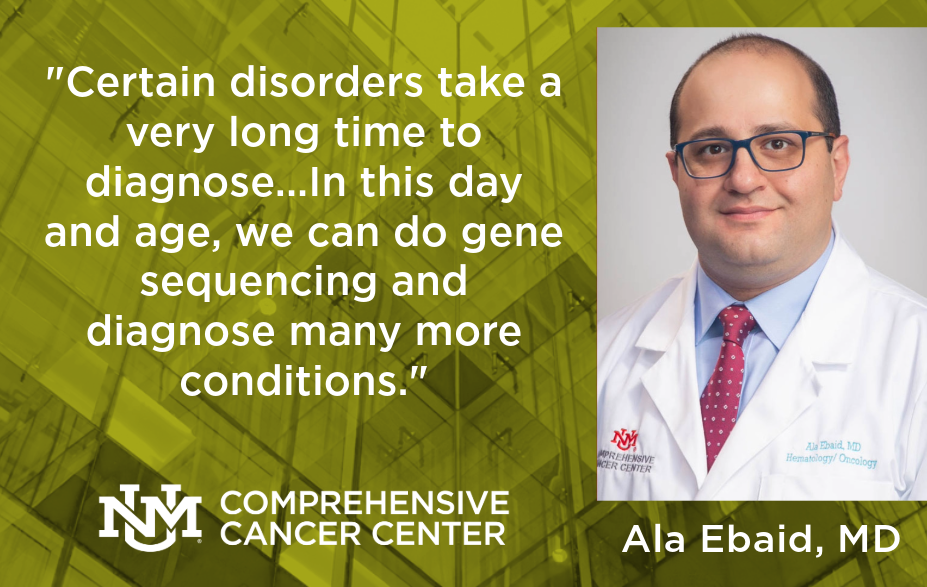
“Certain disorders take a very long time to diagnose,” Ebaid said. “Sometimes the symptoms may overlap with other conditions, or we lack tools to make a diagnosis. In this day and age, we can do gene sequencing and diagnose many more conditions.”
Systemic mastocytosis, a condition where white blood cells called “masts” build up inside the body, often takes longer to diagnose because its symptoms often mirror other allergic reactions, he said. Ebaid suspects the condition is probably underdiagnosed as well.
Having a Classical Hematology Clinic in New Mexico is crucial to treating the wide variety of blood disorders, he said.
Ebaid has been a physician in New Mexico for 15 years but joined the UNM Cancer Center in 2020 as an attending hematologist at the height of the COVID-19 pandemic. From outset, he treated patients with classical hematology disorders, but it would take two more years to establish a formal program.
“It started as a half day for blood clots, and now we have three full days of clinic,” Ebaid said. “Now we have two advanced provider practitioners. The support from the (UNM Cancer Center) leadership allowed us to expand to provide this care. We are the only Classical Hematology program in New Mexico.”
The clinic also helps educate the next generation of physicians and pharmacists. Fellows in hematology-oncology as well as residents in internal medicine and in pharmacy will spend some time in the clinic learning about the care there.
The clinic is busy. It received more than 600 referrals last year and saw more than 2,500 patients.
For Logan, the treatment she receives at the clinic has been life changing.
“I’ve been on it for about a year and a half,” she said. “This summer it really has made a difference. If I go out on a boat or something I still put on a long sleeve shirt and a hat. But I’m comfortable. I can drive around without gloves and a long sleeve shirt. I still have a shirt and gloves in the back seat, but I’m way more comfortable. It made a world of difference.”