UNM Cancer Center
Media Contacts
Call or text:
505-548-0927
Email Jeff Tucker
Email Michele Sequeira
A new clinic at The University of New Mexico Comprehensive Cancer Center is working to treat cancers on the outside and inside of patients' bodies.
David Savage, MD, PhD, recently launched a specialty clinic to treat skin cancers and soft tissue sarcomas.
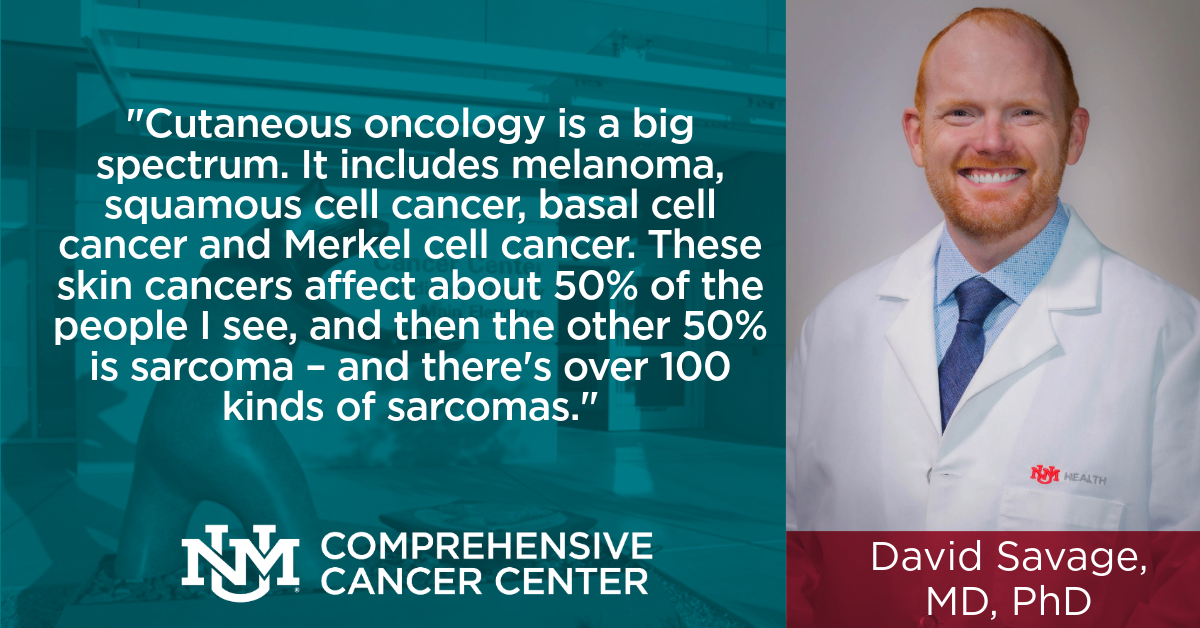
“My clinic here is cutaneous oncology and sarcoma,” Savage said. “Cutaneous oncology is a big spectrum. It includes melanoma, squamous cell cancer, basal cell cancer and Merkel cell cancer. These skin cancers affect about 50% of the people I see, and then the other 50% is sarcoma – and there's over 100 kinds of sarcomas.”
“Soft tissues” is a collective term for the muscles, fat and venous tissues in the body that often are adjacent to organs but are not the organs themselves.
Cancers that develop on an organ are typically named for that organ: stomach cancer, pancreatic cancer, colon cancer. But cancers can also grow in the adjacent soft tissues, and those are the sarcomas Savage treats.
“A (soft tissue) sarcoma is a tumor that can occur in the soft tissues in the body,” Savage said. “Liposarcoma, for example, can occur when a fatty tissue becomes invasive and cancerous. It’s one that we see often.”
Sarcomas are not easily detected, however.
They’re typically discovered after a patient exhibits a symptom, Savage said.
Bloating or abdominal pain that can't easily be explained will send a patient to a hospital, where the sarcoma will be discovered, he said.
“That's how a lot of sarcomas are found,” Savage said. “Either there is a growth somewhere that is protruding from the body, or somebody feels a symptom and then that leads to a scan that then leads to a biopsy and a diagnosis.”
Because there’s such variation, sarcomas can be difficult to treat as well.
Savage relies on a network of other experts both at the UNM Comprehensive Cancer Center and elsewhere to plan the best treatments for his patients. These can involve chemotherapy, radiation, surgery, targeted therapy – and sometimes immunotherapy. The multidisciplinary sarcoma team meets regularly to ensure that care is coordinated and sequenced to provide the best outcomes for patients.
“It's a lot of legwork. Before I even meet a patient, I already have a scan and a biopsy and some pathology results,” Savage said. “I'm doing a lot of work to try to figure out how can we best treat this person.”
A team approach is an important part of treatment for both sarcomas and skin cancers, Savage said. His practice overlaps with other physicians who treat some of these types of cancers.
Bone cancers are part of the family of sarcomas and Savage works closely with UNM Cancer Center’s orthopaedic oncology team. He also works closely with dermatologists when treating skin cancers.
“Dermatologists are really good at making an initial diagnosis and then they are also great surgeons,” Savage said. “If it's not advanced melanoma, a lot of times I never meet those patients, because they have surgery and they're done. And for future surveillance, they'll continue to see the dermatologists who will do a head-to-toe examination.”
Savage gets involved when a patient has a more severe stage of melanoma, typically when the cancer has spread.
“Because it's already spread, the cat’s out of the bag,” he said. “So, they send them to me to use medical treatment to try to get things under control.”
Advancements in medical treatments for melanomas are what drew Savage into the field in the first place, he said.
After completing his bachelor's degree in biochemistry and computer science from Austin College, he earned his MD and PhD degrees from the University of Texas McGovern Medical School and the UT Graduate School of Biomedical Sciences (Houston) in 2018.
Savage completed his internal medicine residency at the Cleveland Clinic and the University of California, San Diego, in 2021. A hematology/oncology fellowship followed at Scripps Green and the Scripps Clinic in La Jolla, Calif., in 2024.
During his residency, Savage worked with an oncologist who specialized in melanoma treatments.
“I thought that the immunotherapy options were super neat,” he said. “My mentor there offered to work on some projects with me right away.”
When he transferred to University of California San Diego, he found another clinic that was doing nearly the same work he’s now providing at UNM.
Immunotherapies – treatments that utilize a patient’s immune system to fight cancers – are revolutionizing the ways he treats metastatic melanomas, Savage said.
“Immunotherapy still really takes the cake,” he said. “To put it in perspective, about 12 years ago, cancer treatment was chemotherapy, radiation, surgery – and that was kind of it. When immunotherapy became readily available, now you had a whole new treatment paradigm for a lot of tumors.”
Even after melanoma patients have gone through their treatments with him, Savage works with dermatologists to be sure patients receive follow up surveillance for any new or recurring skin cancers.
Having access to so many colleagues as part of a National Cancer Institute-designated comprehensive cancer center helps make his clinic more effective because there is a larger collective of expertise, as well as open lines of communication among teams of doctors who may be treating the same patient.
Savage also has some interest in research projects, but said he’s primarily focused on finding clinical trials for his patients. He’s also interested in public health and cancer outcomes.
“I’m interested in looking at what are the long-term outcomes and support for patients with cancer, and how we, as a cancer community, could be doing a better job of taking care of patients,” he said.
The University of New Mexico Comprehensive Cancer Center
The University of New Mexico Comprehensive Cancer Center is the Official Cancer Center of New Mexico and the only National Cancer Institute-designated Cancer Center in a 500-mile radius. Its 136 board-certified oncology specialty physicians include cancer surgeons in every specialty (abdominal, thoracic, bone and soft tissue, neurosurgery, genitourinary, gynecology, and head and neck cancers), adult and pediatric hematologists/medical oncologists, gynecologic oncologists, and radiation oncologists. They, along with more than 600 other cancer healthcare professionals (nurses, pharmacists, nutritionists, navigators, psychologists and social workers), provide treatment to 65% of New Mexico’s cancer patients from all across the state. And they partner with community health systems statewide to provide cancer care closer to home. In 2024 they treated more than 15,000 patients in almost 105,000 ambulatory clinic visits in addition to in-patient hospitalizations at UNM Hospital. A total of 2,075 patients participated in cancer clinical trials to study new cancer treatments that include tests of novel cancer prevention strategies and cancer genome sequencing. The more than 123 cancer research scientists affiliated with the UNM Cancer Center were awarded $38.3 million in federal and private grants and contracts for cancer research projects. Since 2015, the physicians, scientists and staff have provided education and training experiences to more than 750 high school, undergraduate, graduate, and postdoctoral fellowship students in cancer research and cancer health care delivery.
Website: unmhealth.org/cancer
UNM Cancer Center Clinic: 505-272-4946
UNM Cancer Center Community & Media Relations: 505-548-0927