


Michael Baker, MPH, RN, didn’t set out to become a nurse. Born and raised in Albuquerque, he found his calling later in life while caring for his grandmother as she faced amyotrophic lateral sclerosis (ALS).
“I really realized during that time that I liked caring for others and being present with other people during really important times in their life,” Baker said. “She actually recommended I go to nursing school. So, that’s what inspired me, and, thanks to her, I found my passion.”
That passion led Baker from a local community college to a role in pediatric oncology at The University of New Mexico Hospital. He earned his Bachelor of Science in Nursing (BSN) and later a Master of Public Health (MPH), but his path ultimately brought him back to the UNM College of Nursing for a Doctor of Philosophy (PhD) in Nursing.
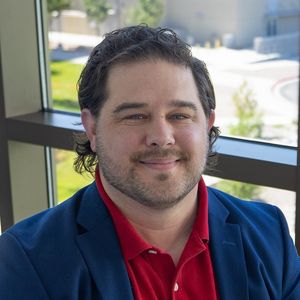
To me, my patient is my community.
– Michael Baker, MPH, RN, PhD Student, UNM College of Nursing
“I think with any nursing program, whether it be a bachelor’s all the way to a terminal degree, it’s going to be very intensive,” Baker said. “It’s going to ask a lot of you, but the payoff is worth the work.”
A PhD in Nursing prepares nurses to generate new knowledge and advance the science of nursing, shaping how health care is understood, delivered and influenced through policy. Now in the dissertation phase of the PhD program, Baker’s research focuses on how nurses influence community health – not just at the bedside, but at the voter polls.
“I’m very interested in how nurses show up to the ballot in their communities through their civic engagement, to make their parks, their libraries or schools, and just their communities overall healthier,” he said. “To me, my patient is my community.”
The College’s PhD program is centered on independent research. Students work closely with faculty to shape a plan of study focused on a particular population, health issue or setting. Didactic classes are completely online, paired with an annual weeklong on-campus residency.
Why a PhD at UNM?
- Primarily online, full or part time
- Concentrations in Health Policy and Health Equity and Preparedness
- Scholarship and grant dollars available
- Faculty leading the field in research and practice
“Our program prepares our graduates for leadership positions in various settings including academia, research institutions, federal agencies and industry,” said Sharon Ruyak, PhD, RN, CNM, FACNM, who is the PhD program director at the UNM College of Nursing. “Through rigorous training and faculty mentorship, our graduates are prepared to advance nursing science and address complex health care challenges.”
Baker describes the program as both rigorous and supportive.
“It is a very challenging and a very demanding program, but it is in a supportive environment, and the payoffs have been wonderful along the way,” he said. “I’ve met amazing researchers; I’ve met amazing scientists; I have been able to publish articles and really advance the field of nursing, thanks to the College of Nursing.”
Baker also credits faculty and mentors with guiding his academic growth.
“Thanks to my PhD advisor, I was able to navigate the curriculum and hone my research interests so that when I came to the dissertation phase, I was able to find a PhD mentor within the College of Nursing faculty that helped guide me and mentor me as I developed my dissertation and became a nurse scientist,” he said.

Our program prepares our graduates for leadership positions in various settings including academia, research institutions, federal agencies and industry.
– Sharon Ruyak, PhD, RN, CNM, FACNM, PhD Program Director, UNM College of Nursing
Baker emphasized how the program creates opportunities for connection with the larger research community.
“The College of Nursing really facilitates networking,” he said. “They require students to go to one conference a year and also to submit abstracts and proposals. Because of that, it really helps remove the hesitation and the nervousness around presenting research.”
What surprised him most was the support system he found among fellow students.
“I found community within my other student peers that we were able to really share the burden and stress of a PhD program,” Baker said. “I feel the relationships I’ve built with them will last me the rest of my career.”
Though the challenges are real, Baker is confident in the journey he’s chosen.
“They really helped me find where I wanted to be,” he said. “With that, I’m able to enter my dissertation phase with clear eyes and a clear direction. Even though it’s still a work in process, I know what I’m trying to achieve.”
Learn more about the College of Nursing’s DNP and PhD programs, including curriculum, format and application deadlines, to help you choose the degree that fits your career goals.


